A Resource for Instructors: Lesson Plan: Illustrated Depictions of Sarah Baartmann, the Hottentot Venus

A Resource for Instructors
Lesson Plan: Illustrated Depictions of Sarah Baartmann, the Hottentot Venus
  • Show the following:

    Annotations
    Resources
  • Adjust appearance:

    Font
    Font style
    Color Scheme
    Light
    Dark
    Annotation contrast
    Low
    High
    Margins
  • Search within:
    • Notifications
    • Privacy
  • Project HomeVénus Noire
  • Projects
  • Learn more about Manifold

Notes

table of contents
  1. Introduction
  2. Interactive Timeline
  3. Lesson Plans: Overview
    1. Lesson Plan: Illustrated Depictions of Sarah Baartmann, the Hottentot Venus
    2. Lesson Plan: Literary Analysis of Ourika, by Claire de Duras
    3. Lesson Plan: Baudelaire’s Theatrical Duval, in English French
    4. Lesson Plan: Three Black Women in Conversation, Unifying Discussion
  4. Selected Bibliography

Lesson Plan: Illustrated Depictions of Sarah Baartmann, the Hottentot Venus

Plan: This is a classroom activity designed to encourage students to critically analyze primary source images that would have circulated in popular culture to understand how these illustrations perpetuated racial and cultural constructions that contributed to the establishment and enforcement of British and French identities.

In preparation for this class, students are expected to have read to the end of Chapter Two, “Entering Darkness: Colonial Anxieties and the Cultural Production of Sarah Baartmann.”


A Pair of Broad Bottoms
William Heath, A Pair of Broad Bottoms, 1810, https://commons.wikimedia.org/wiki/File:A_Pair_of_Broad_Bottoms.jpg.

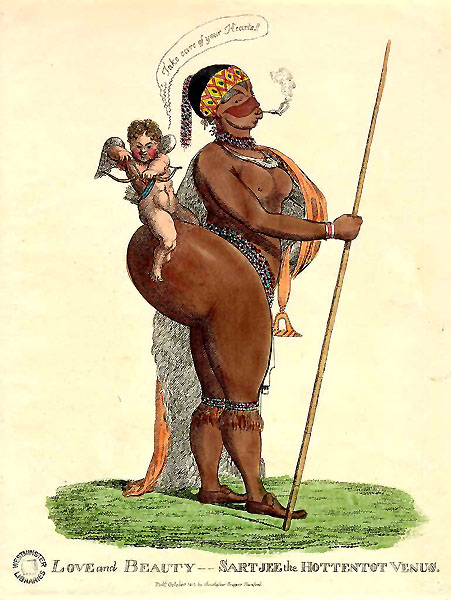
Baartman
Charles Williams, Love and Beauty - Sartjee the Hottentot Venus, 1822, Hand-colored etching, https://commons.wikimedia.org/wiki/File:Baartman.jpg.

The March of Morality
William Heath, The March of Morality, September 1827, Hand-colored etching, 8 7/16 in. x 12 15/16 in., https://www.metmuseum.org/art/collection/search/841187.

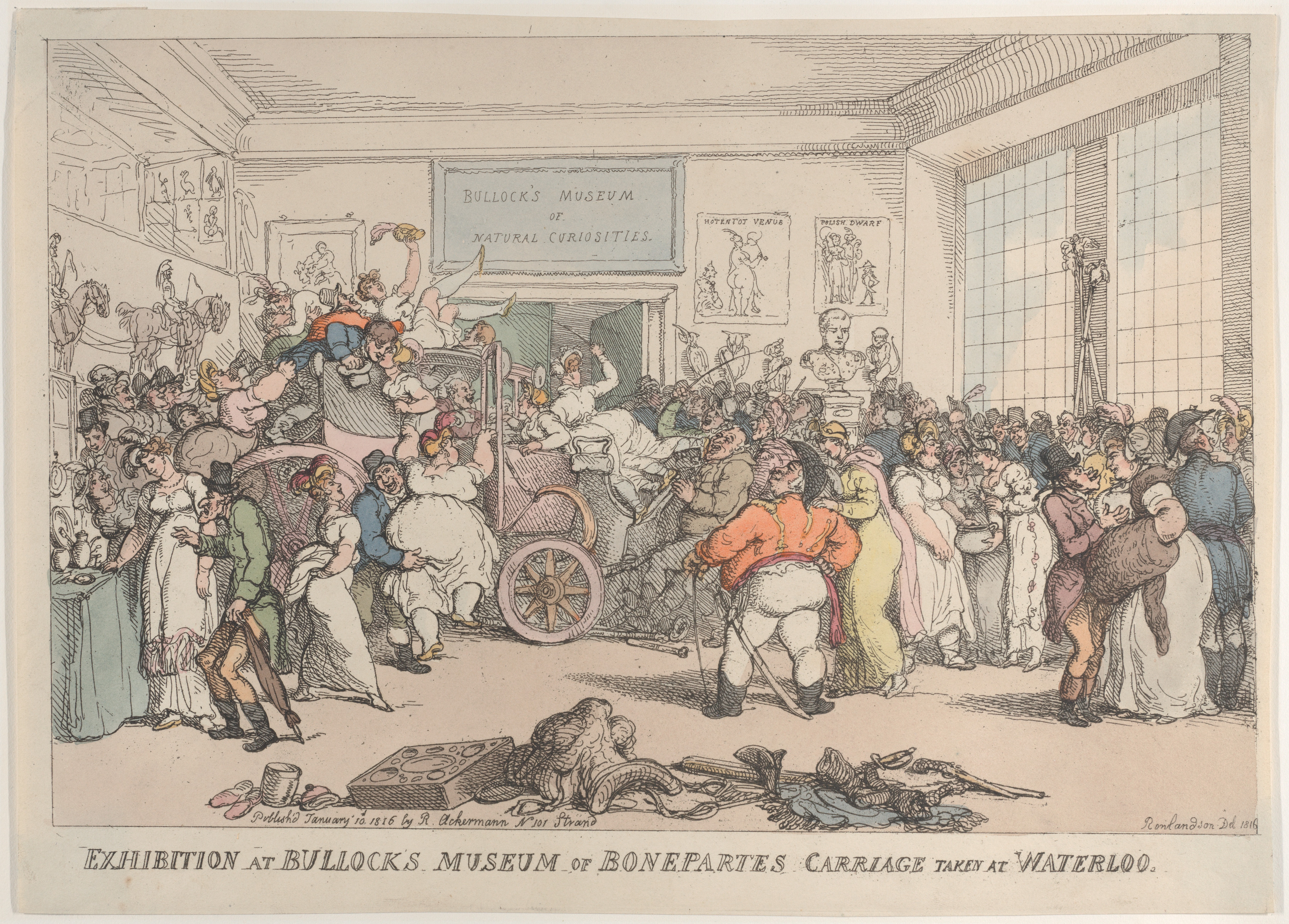
Exhibition at Bullock's Museum of Bonaparte's Carriage Taken at Waterloo
Thomas Rowlandson, Exhibition at Bullock’s Museum of Bonaparte’s Carriage Taken at Waterloo, January 10, 1816, Hand-colored etching, 8 1/2 x 12 3/4 in., https://www.metmuseum.org/art/collection/search/363422.

The Court at Brighton a la Chinese
George Cruikshank, The Court at Brighton à La Chinese, 1816, Hand-colored etching, https://www.britishmuseum.org/collection/object/P_1868-0808-12823.

The New Union Club
George Cruikshank, The New Union-Club, 1819, Hand-colored etching, https://www.britishmuseum.org/collection/object/P_1859-0316-148.

Les Curieux En Extase, Ou Les Cordons de Souliers
Louis François Charon, Les Curieux En Extase, Ou Les Cordons de Souliers, 1815, Hand-colored etching, https://www.britishmuseum.org/collection/object/P_1998-0426-7.

Every Man in His Humour
J Lewis Marks, Every Man in His Humour, 1824, Hand-colored aquatint, https://www.britishmuseum.org/collection/object/P_2006-0929-60.

Love at First Sight. Or a Pair of Hottentots, with an Addition to the Broad Bottom Family!
William Heath, Love at First Sight. Or a Pair of Hottentots, with an Addition to the Broad Bottom Family!, 1810, Hand-colored etching, https://www.britishmuseum.org/collection/object/P_2006-0929-60.

Sample Discussion Prompts

  • What are the most significant similarities in the portrayal of Baartmann across the multitude of illustrations? What do these similarities reveal about Baartmann’s position in the racial conceptions of these white European societies? And how may these depictions contribute to the perception of Black women in these white “civilized” cultures?

  • How do these illustrations communicate a sense of power and influence being exercised? What does the specific “command” that Baartmann possesses over the “civilized” Europeans expose about the conceptions of Black women in British and French societies?

  • What role does the viewer of the illustrations play in the perpetuation or refutation of the stereotypical portrayals of Baartmann as a Black woman?

Annotate

Next Chapter
Lesson Plan: Literary Analysis of Ourika, by Claire de Duras
PreviousNext
Powered by Manifold Scholarship. Learn more at
Opens in new tab or windowmanifoldapp.org